
3D printing for circularity: three examples of how plastic alternatives can contribute to sustainable development
3D printing has always primarily relied on polymer-based filaments or pellets, such as TPU and ABS, for the production of prototypes and on-demand components. However, the use of virgin polymers contributes significantly to plastic pollution, while more sustainable alternatives, such as PLA, still require controlled composting conditions to degrade properly at the end of their service life.
Biodegradable and compostable material for 3D printing

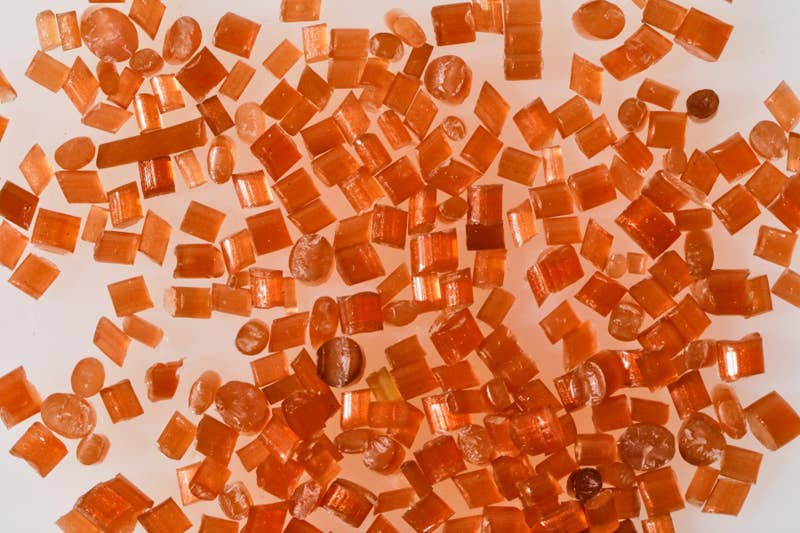
This first example is a biodegradable and industrially compostable material with a high mineral content that represents a sustainable alternative to conventional plastics. Described as a “3-in-1” substitute, it is suitable for injection molding, thermoforming, and 3D printing.
The material contains 30% limestone (97% pure CaCO₃) together with plant-based compounds, achieving a certified bio-based content of 60 wt.% and is free of BPA and phthalates. It exhibits excellent mechanical properties, with performance comparable to HDPE and several grades of PP and ABS. Certified under the USDA BioPreferred® Program, it represents a viable alternative to conventional plastics for applications in packaging, furniture, and consumer goods.
Bio-based composites from household waste

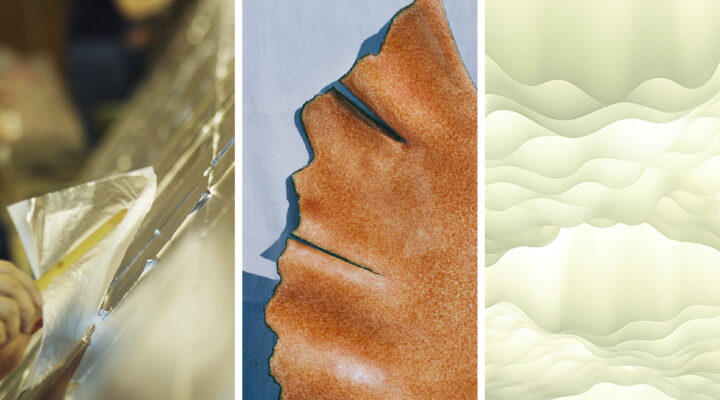
Another example is a patented process that converts household waste into bio-based composites. After collection, recyclable materials such as glass and metals are separated and sent for recycling while the remaining materials – consisting of food waste, contaminated plastics, paper, and cardboard – are dried and ground into a fine powder. The powder is then processed in a reaction chamber, where it is transformed into a composite material with properties similar to those of bio-based plastics.
The resulting composite can be used as an additive (15–30 wt.%) in sustainable plastics or in its pure form for injection molding, additive manufacturing, and compression molding. The process generates no greenhouse gas emissions or waste by-products, requires low energy consumption, and uses no water, making it a promising solution for high-impact sectors such as construction.
Compostable bioplastic from renewable raw materials

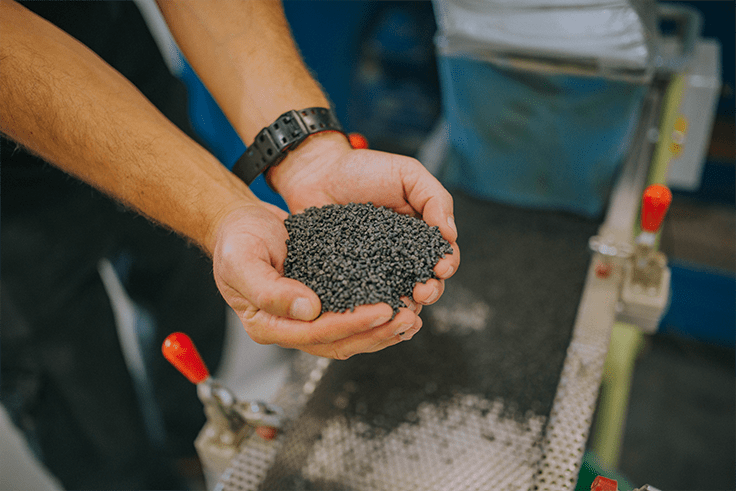
The final example is a compostable bioplastic made entirely from renewable raw materials, including corn starch, sugarcane and potato starch. Developed for mass production, it consists of a patented blend of polylactic acid (PLA) and polyhydroxyalkanoate (PHA), making it suitable for 3D printing, injection molding, hot pressing, and extrusion.
The material is biocompatible, non-toxic and hypoallergenic, making it suitable for food-contact applications. It withstands temperatures of up to 100 °C without losing its properties and can remain durable for decades during use. At the end of its life cycle, prolonged exposure to water enables the material to degrade completely in approximately 120 days. The company has also developed a range of colored products using natural pigments derived from plant-based waste, such as coffee grounds, turmeric, and indigo. These dynamic properties allow the material to be used for applications across design, furniture, fashion accessories, packaging, and consumer goods.
Discover more circular materials on Materials Insights.
Access Materials Insights and discover over 10,000 innovative materials, case studies and trends contributing to the development of more circular production models.
For more information, contact us at info@materially.eu