
Additive Manufacturing enabling circular economy
In recent years, 3D printing has become an important sustainable alternative to conventional manufacturing processes. Thanks to additive manufacturing, material waste is significantly reduced, enabling the production of customized, on-demand products. Today, 3D printing is widely applied in Large-Format Additive Manufacturing (LFAM), allowing the fabrication of large-scale structural elements and components using materials ranging from concrete and metals, to bio-based plastics and composite materials. In some cases, these materials can be recovered at the end of their service life and reintroduced into the production cycle to manufacture new products. For these reasons, 3D printing and the materials employed in the process represent key technologies in supporting the transition toward a circular economy model and closed-loop manufacturing system.
MAGRITTE: high-performance materials for large-format 3D printing

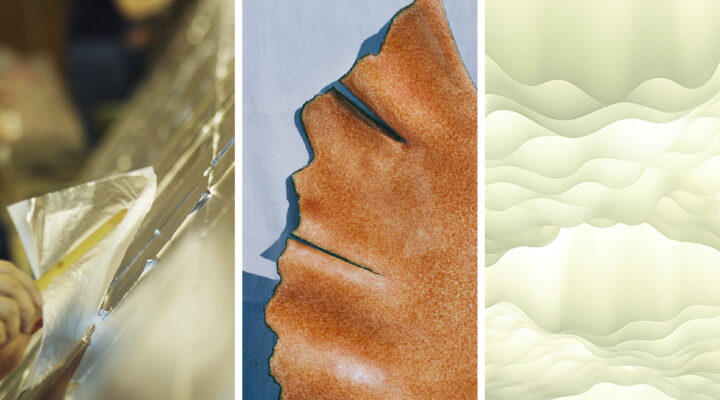
A first example is the MAGRITTE project, developed through the collaboration between Tessilquattro (Aquafil Group), the University of Trento, Indivenire, ProM Facility (Trentino Sviluppo), and Caracol AM. The project led to the development of a high-performance composite material for large-format 3D printing, aiming to combine technical performance, design, and material circularity. The material is made of ECONYL® nylon, a chemically regenerated polyamide 6 produced from discarded fishing nets, textile waste, and end-of-life carpets, reinforced with clay to enhance its mechanical and aesthetic properties. One of the project’s key innovations is the elimination of glass fiber, a reinforcement commonly used in 3D printing composites. By avoiding its use, the developed material can be easily recovered at the end of its service life and reintroduced into the manufacturing process.
Additive Nodes: zero-waste design and disassemblable architecture

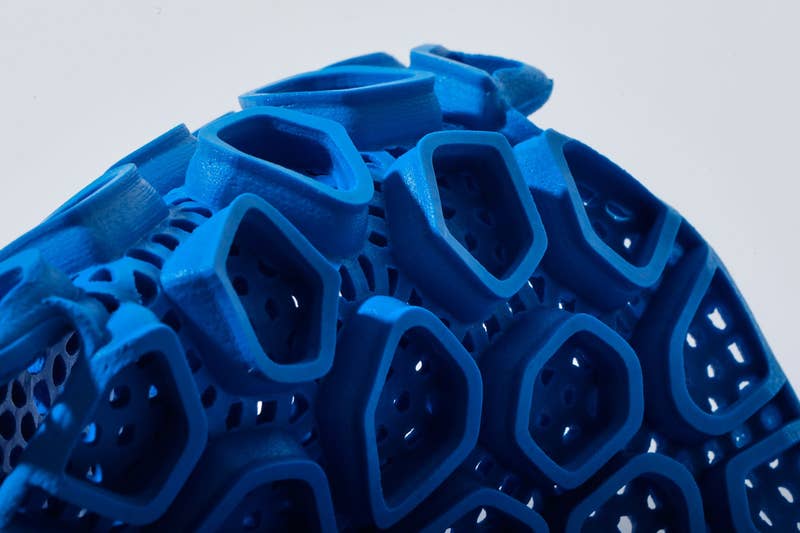
The Additive Nodes project, developed by architectural designer Sina Lüder in collaboration with Polymaker and Ginger Additive, is characterized by a zero-waste and circular design approach. The structural nodes made for the Ginger Pavilion – manufactured through Large-Format Additive Manufacturing (LFAM) using PolyCore™ PETG-1312, a pellet-based composite containing 30 wt.% glass fiber -, are designed to be recycled at the end of their service life. They can be shredded, reprocessed into pellets, and reused to manufacture new high-performance components. Selected for its excellent resistance and high flexural modulus, the material provides the mechanical performance required for complex architectural applications. The project also embraces the principles of disassemblable architecture, showing how Big Area Additive Manufacturing (BAAM) can be used to create modular, reversible, and reusable structures.
Lithic Flow Divider: robotic extrusion and circular material flows

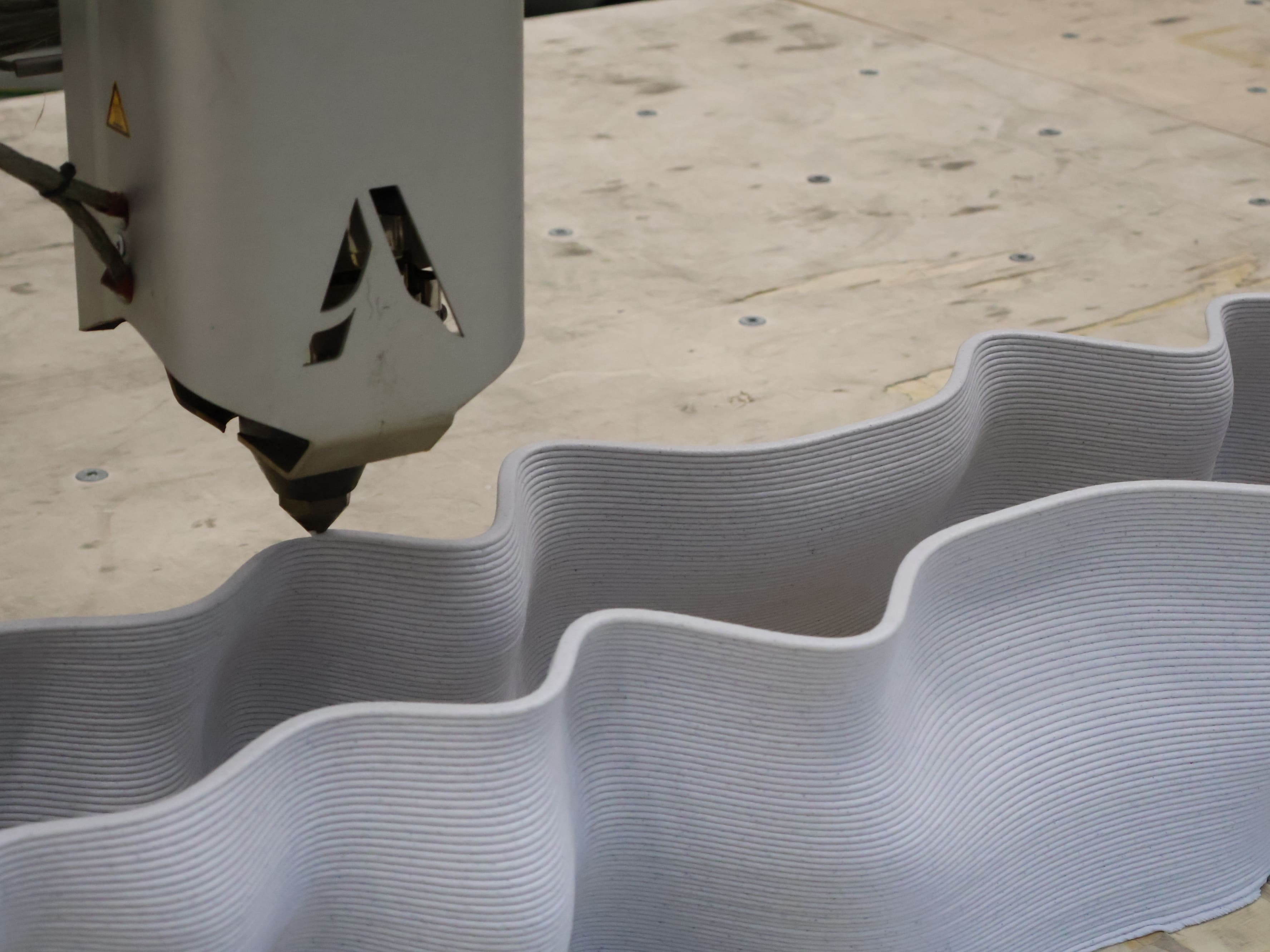
Another project based on the same zero-waste and circularity principles is Lithic Flow Divider, developed by Polymaker in collaboration with Caracol AM. Designed by Massimiliano Boz and Giacomo Tomesani and manufactured through Large-Format Additive Manufacturing (LFAM), the partition panel is printed using PolyCore™ PETG-1113 Marble, a glass fiber-reinforced composite that can be mechanically recycled at the end of its service life and reintroduced into the production cycle.
The project demonstrates how robotic extrusion can combine structural performance with aesthetic quality through a material that resembles natural stone while highlighting the layer-by-layer deposition process. Its geometry was generated using Cinema 4D, where a planar surface was simulated with the physical behavior of water and then transformed into a full-scale physical object through robotic additive manufacturing.
Bring your innovation to London and Dubai with Materials in Motion, the program by Materially designed to give international visibility to innovative materials and technologies.
For information and details on how to participate, email us at info@materially.eu.