Phygital Futures: towards new Interactions for Wellbeing
In a world where the role and value of physicality is changing at an ever-increasing pace, the boundary with the digital world is becoming increasingly blurred, giving rise to a phygital context capable of generating hybrid, fluid and more engaging interactions.
Phygital as a new sensory habitat
Dematerialised interactions — enabled by sensors and chips embedded in wearables and devices — are reshaping modern medicine, bringing advanced solutions into everyday life and greatly easing patients’ routines. This evolution is also giving rise to a new form of sensory wellbeing, where AI-driven experiences blend with soft, calming interfaces to offer immersive journeys that continuously evolve.

Acromnia Orbital Hotel: living in a phygital future
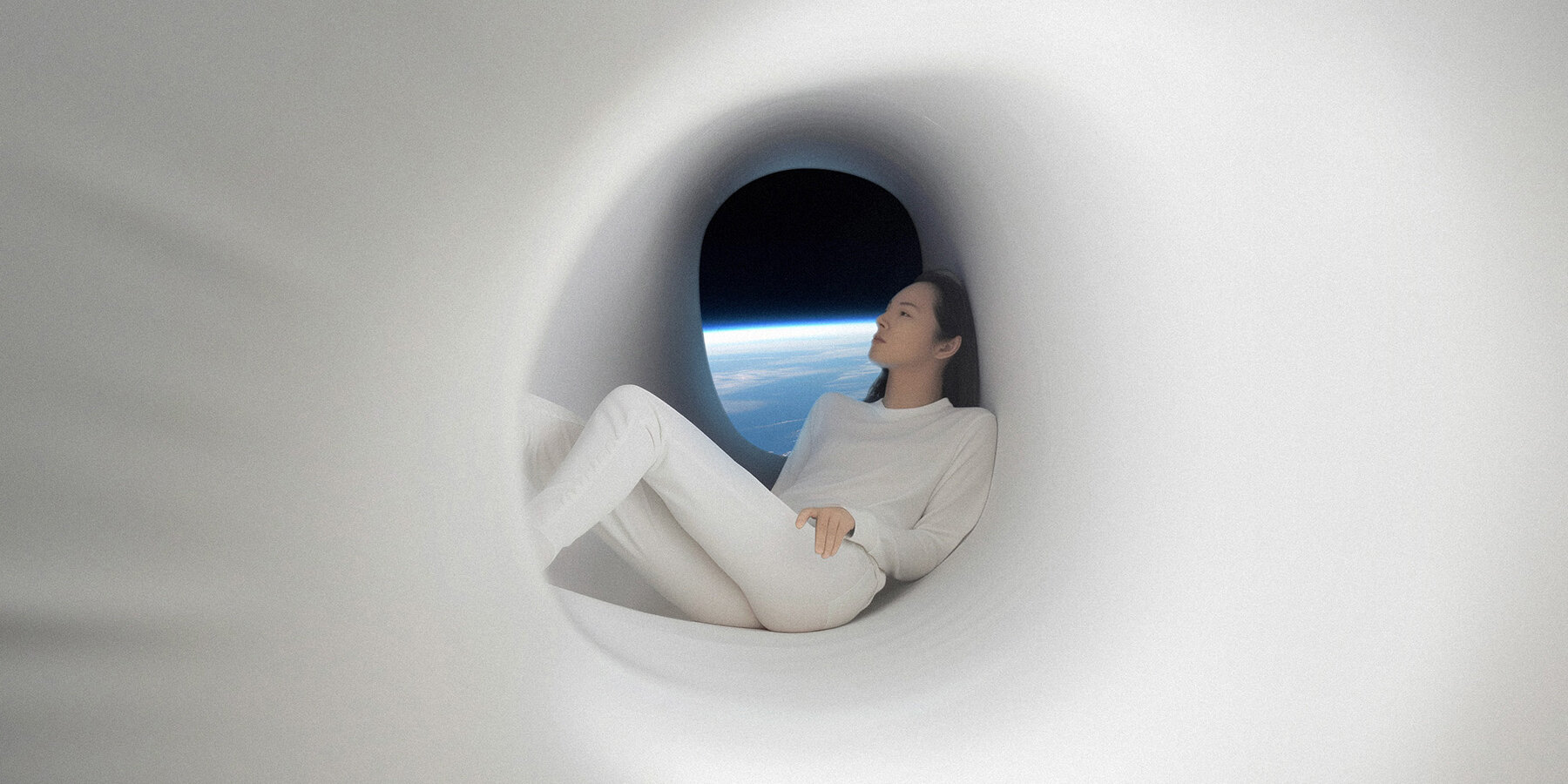
In the Acromnia Orbital Hotel, designed by Acromnia Studio, new realities and experiences are imagined as alternatives to those we know today. This speculative design project envisions a new way of inhabiting space, projecting humans beyond Earth into a realm of space tourism, where people are surrounded by reactive materials with intelligent, ever-changing properties.
The environment is conceived as an unspoiled, fluid space, free of furniture, doors or traditional architectural elements. Its surfaces feature pores that allow air, sound, light and scents to permeate.
Each zone dedicated to individual activities is formed by autonomous units, where furnishings emerge and adapt according to the needs of the user. The space becomes a platform for new forms of connection, encouraging introspection and exploration, and offering a cosmic perspective on humanity.

Brain-Computer Interface: thought as an interfac
More tangible is the partnership between Apple and the US neurotechnology company Synchron, which has led to the development of products — including iPhones and iPads — that can be operated through brain implants. The implantation procedure, comparable to placing a stent, is minimally invasive and avoids the need for open brain surgery. Designed to remain stable inside the body, it supports patients with limited mobility in their daily tasks, enabling them, for instance, to book medical appointments or send messages simply by controlling the devices with their thoughts.
The ambition is to open the way to a new interface paradigm, where brain signals are recognised just like touch, voice or typed input. In this context, Brain–Computer Interface (BCI) technology emerges as a promising frontier, with the potential to enhance the lives not only of patients but also of their families.

MouthPad^: the intraoral interface that frees your hands
One removable solution is Augmental’s intraoral medical interface, MouthPad^, which enables users to control their devices via Bluetooth and communicate without using their hands.
Attached to the palate, the device supports both head and tongue tracking for cursor navigation, using a lingual trackpad to perform actions such as clicking, dragging and scrolling. Originally designed for people with spinal cord injuries, MouthPad^ is based on the idea that the human tongue can function as an “eleventh finger” thanks to its versatility and ability to learn complex movements — a concept that could open future applications for able-bodied users as well.
This technology expands the possibilities for more inclusive, intuitive and accessible interaction, redefining the relationship between body and device and giving more people the opportunity to communicate and operate independently. At the same time, it introduces an interface model that could extend beyond the medical sector, influencing the design of future hands-free control systems and contributing to a vision of technology that truly adapts to diverse human needs.
New materials, technologies and phygital integrations will be featured at The New State of Materials during Milan Design Week 2026. The exhibition organised by Materially will be a central and authoritative stage for researchers and companies dedicated to responsible innovation in the field of materials. If you would like to participate, contact us at info@materially.eu.