The 2026 Olympics and the green evolution of sports materials
On February 6th, the 2026 Winter Olympic Games will kick off, a must-see event that attracts millions of visitors from all over the world. While this unique show offers unforgettable experiences among iconic landscapes and evocative ceremonies, it also generates a significant environmental impact, due to high CO₂ emissions and to extensive consumption of energy and water resources.
In response to these challenges, initiatives such as Now26 were born, with the aim of coordinating and promoting concrete actions to reduce the environmental impact of events, encourage responsible tourism, safeguard human rights, and leave a positive legacy for future generations.
Sustainability has also progressively entered sports itself: not only shaping the final product, but increasingly influencing materials, manufacturing processes, and the end-of-life of equipment. Snowboards and sports components thus become true platforms for advanced experimentation, where circular economy principles, bio-based materials, and carbon footprint reduction coexist with extremely high performance requirements.
Re - Up Tech to recycle old snowboards
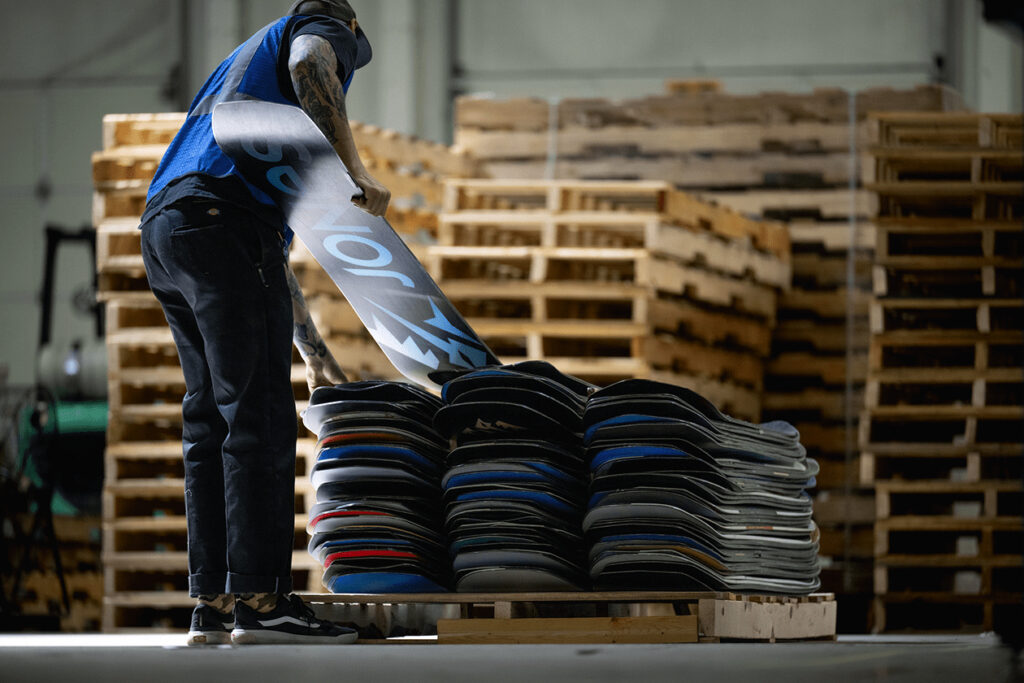
One of the first brands to address the issue is Jones Snowboards, which has innovated its production cycle by recovering old snowboards through the Re-Up Tech recycling process. The company is able to manufacture high-performance snowboards using up to 95% of the materials from a discarded board.
The steel edges are removed and recycled, while most of the board is cut and reused to create reinforcements – traditionally made from carbon fiber, Kevlar, or premium wood – for new boards. Six flattened boards, of any brand or composition, are then stacked, bonded, and pressed to form a 24-layer sandwich. This sandwich is finally sliced into thin layers that are inserted as performance reinforcements inside the board.
The resulting material is stiff and durable, delivering performance equivalent to that of products made from virgin materials. Through this approach, the brand – working with SWS Board Technology, the manufacturer of Jones boards and long committed to researching more sustainable production processes – stands as a concrete example of low-impact circularity, achieved through a high-value, long-lasting product.
NanoCarbon and biochar: the technology behind high-performance equipment

Another company that has introduced significant improvements to its products is the Swiss company Oxess. Since 2022, the company has been collaborating with the Ithaka Institute for Carbon Strategies to enhance the physical properties of its snowboards through the use of a patented nano-carbon injection technology. The carbon used is extracted directly from the atmosphere, making each board a small but meaningful concrete action against climate change.
Oxess employs NanoCarbon and biochar technologies (a porous, carbon-rich material produced from plant biomass), giving rise to the C-Sink series, characterized by high dynamic and mechanical performance due to an exceptionally high strength-to-weight ratio. This results in reduced energy loss, greater flexibility, and superior impact resistance, optimizing kinematic efficiency and the athlete’s performance in dynamic sports activities.
Project 83 Eco: the most sustainable ski in the world

A final example is presented from Swedish company Extrem Ski Co, which, in collaboration with Skistar, launched the Project 83 Eco for the 2025/26 winter season.
The Project 83 Eco is considered the most sustainable ski in the world, produced entirely with renewable energy free of fossil fuels from local hydroelectric plants. Manufactured entirely at the Åre facility, the goal from the outset was to create a ski with the highest possible percentage of bio-based and recycled materials, without compromising longevity and performance. The ski is made of 70% recycled ABS, 50% recycled bases, 50% recycled topsheets, and 20% recycled steel edges.
Since 2020, the company has invested in an efficient solution to recover excess heat generated by machinery and to minimize waste from the wooden cores used for the skis, reusing it in the local district heating system. Thanks to these innovations, the Project 83 Eco is likely the most sustainable ski in the world, with a carbon footprint of less than 28.8 kg of CO₂ per pair.